


📋 Project Overview
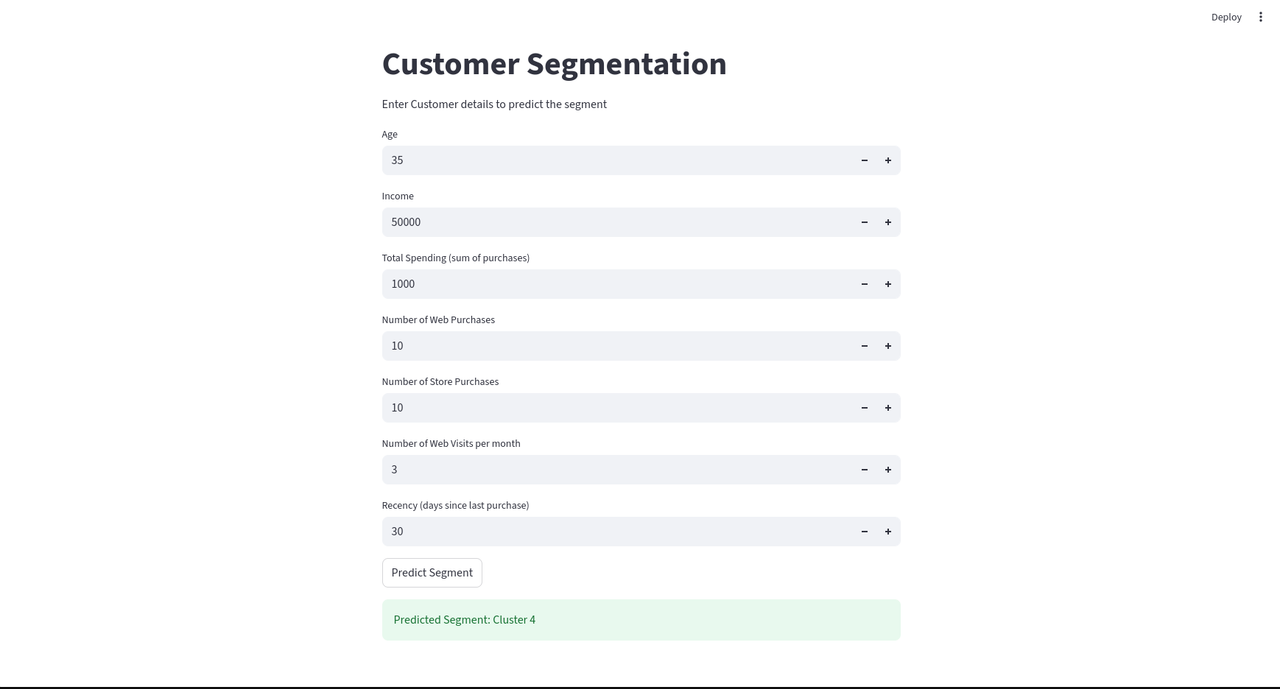
This project implements customer segmentation analysis using K-Means Clustering. The segmentation helps businesses understand their customer base better and develop targeted marketing strategies.
1. Data Exploration & Pre-processing
- Data quality assessment and cleaning
- Missing value treatment
- Feature engineering and selection
2. Exploratory Data Analysis (EDA)
- Statistical summary of customer data
- Distribution analysis of key features
- Correlation analysis between variables
- Visualization of customer patterns
3. Feature Engineering
- Customer lifetime value calculation
- Standardization and scaling
4. Clustering Analysis
- K-Means Clustering: Primary segmentation method
- Elbow Method: Optimal cluster determination
📈 Visualizations
The notebook includes comprehensive visualizations:
- Customer distribution across segments
- Age Distribution
- Income Distribution
- Total Spending Distribution
- Income by Education Level
- Spending by Marital Status
- Correlation Matrix (Income, Age, Recency, Total Spending, Number of Web Purchases, Number of Store Purchases)
- Heatmap (Average Income by Education and Marital Status)
- Average Spending by Education
- Campaign Acceptance Rate by Marital Status
- Average Income by Age Group
- ELbow Method for Optimal Cluster Size
- Customer Segmentation (PCA)
Customer Segments: 0, 1, 2, 3, 4, 5
🎯 Objectives
- Identify Customer Segments: Group customers with similar characteristics and behaviors
- Behavioral Analysis: Understand purchasing patterns and customer preferences
- Business Intelligence: Provide actionable insights for marketing and sales teams
- Marketing Strategy: Enable targeted campaigns and personalized customer experiences
🛠️ Technologies Used
- Python 3.8+
- Pandas - Data manipulation and analysis
- NumPy - Numerical computations
- Matplotlib/Seaborn - Data visualization
- Scikit-learn - Machine learning algorithms
- Jupyter Notebook - Interactive development environment
- Streamlit - Web app framework
📁 Project Structure
Customer-Segmentation/
├── notebook/
│ └── customer_segmentation.ipynb # notebook
├── data/
│ └── customer_segmentation.csv   # Dataset
├── model/
│ └── customer_segmentation.pkl   # trained model
├── src/
│ └── app.py                      # web app
├── requirements.txt              # Python dependencies
└── README.md                     # Project documentation
🔧 Installation & Setup
- Clone the repository
git clone https://github.com/SamanwoySaha/Customer-Segmentation.git
cd Customer-Segmentation- Create virtual environment
python -m venv venv
source venv/bin/activate # On Windows: venv\Scripts\activate- Install dependencies
pip install -r requirements.txt- “Run app”
streamlit run src/app.py